
Gauge-gravity duality · strong coupling · real-time response
Holography
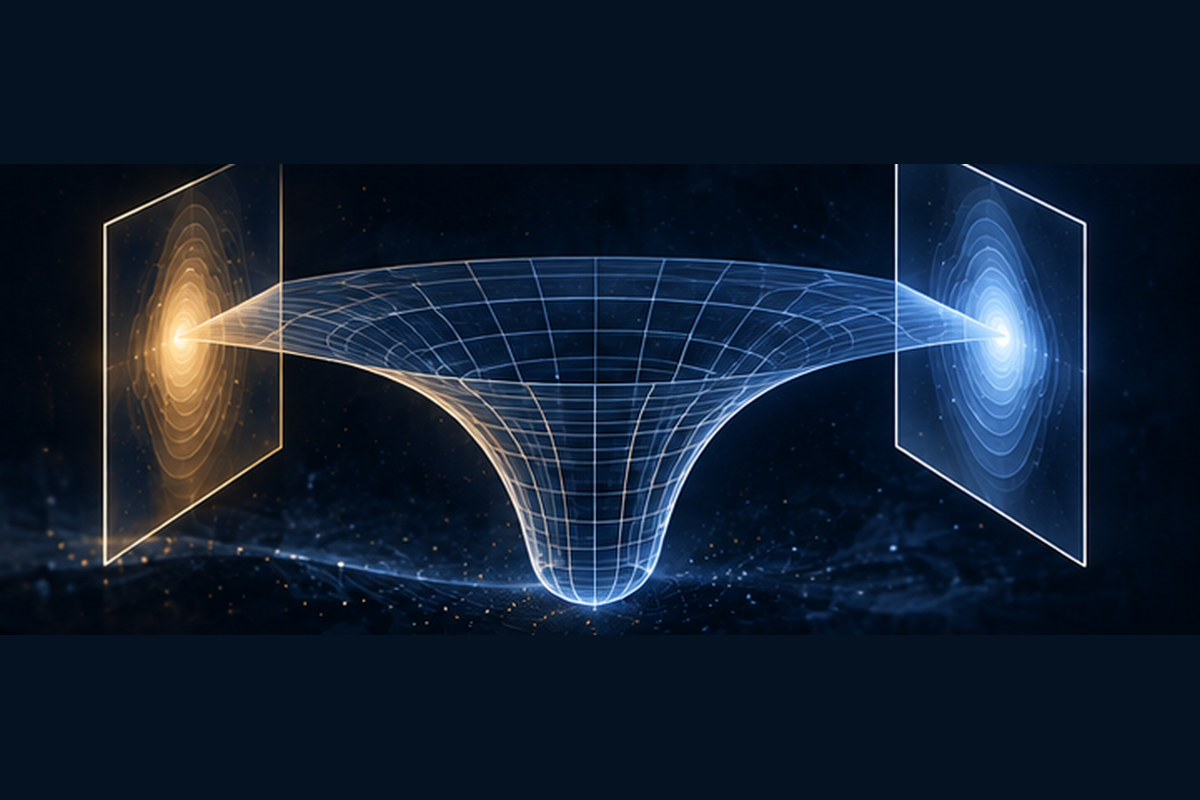
Holography, in the sense used in our work, is the gauge-gravity duality: the statement that certain quantum field theories can be described equivalently by a gravitational theory in one higher dimension. The best understood examples arise from AdS/CFT, where a strongly coupled field theory lives on the boundary of an asymptotically anti-de Sitter spacetime. The dictionary is useful because difficult many-body questions on the field-theory side can become classical boundary-value problems in gravity. At finite temperature the dual geometry contains a black hole, sources for field-theory operators are encoded in boundary values of bulk fields, and the quasinormal modes of the black hole determine poles of retarded correlation functions. This gives access to thermodynamics, transport and real-time relaxation in regimes where ordinary perturbation theory is ineffective. Holography is not a claim that every strongly correlated material literally possesses a simple gravitational dual. Its value is that it supplies controlled strongly coupled theories in which general ideas about transport, collective modes and effective descriptions can be calculated and tested explicitly.
The subject has moved well beyond the original calculation of equilibrium observables. Holographic models now provide laboratories for momentum relaxation, strange-metal transport, superconductivity, charge-density waves, phonons and other phases with broken symmetries. Real-time response has become increasingly important: quasinormal spectra let one follow the transition from hydrodynamic poles to non-hydrodynamic relaxation, while the analytic continuation of correlators exposes pole collisions, branch structure and the limits of low-frequency effective theories. Duality transformations can reorganise the same response in nontrivial ways by exchanging poles and zeros. Holography has also become intertwined with effective field theory rather than standing apart from it. One can derive hydrodynamic coefficients from gravity, identify additional long-lived degrees of freedom, and then ask which part of the gravitational answer can be reproduced by a local or quasihydrodynamic action. This is a more demanding use of the correspondence than simply producing a transport curve: the gravitational model becomes a microscopic benchmark against which the assumptions of an infrared theory can be tested.
Our holographic work has followed precisely this route. We have studied transport in systems with momentum relaxation, magnetic fields and charge-density-wave order, including holographic phonons and the emergence of universal relaxation scales. We have used probe-brane systems and electromagnetic duality to understand strongly coupled quantum matter, including cases in which changing the quantisation or applying an SL(2,Z) transformation changes the pole content that an infrared effective theory must retain. Holography also provides a controlled setting for our work on driven steady states and quasihydrodynamics, where forcing is balanced by relaxation and additional slow modes modify ordinary hydrodynamic response. More recently, we have used black-hole quasinormal modes and holographic correlators to study the analytic structure that ultimately limits hydrodynamic expansions. In all of these applications the gravitational construction is not the final objective. We use it to obtain exact or numerically controlled information at strong coupling, and then ask which features are universal enough to survive in an effective description that can be compared across holography, quantum field theory and condensed-matter systems.