
Active
Complex momentum · non-hydrodynamic modes · response
Analytic structure and the limits of hydrodynamics
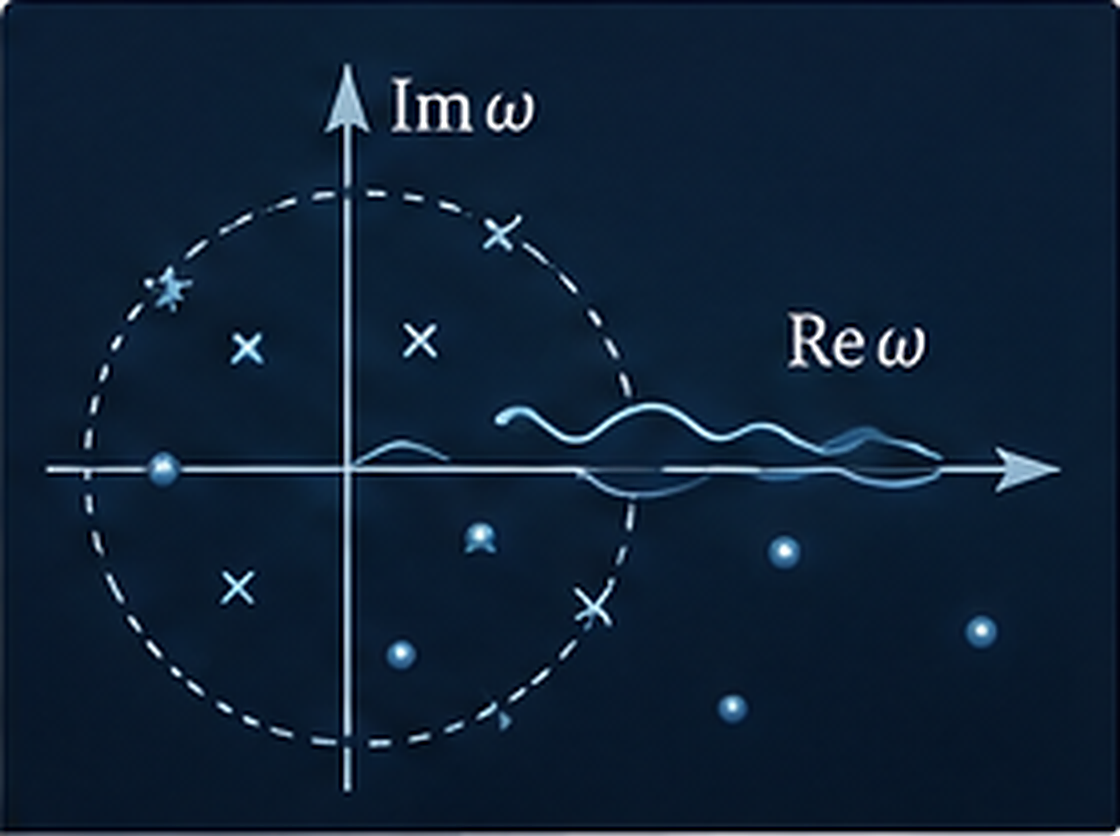
We study where hydrodynamic expansions stop being analytic and what that breakdown reveals about microscopic dynamics. The programme compares static screening scales with dynamical pole collisions, follows quasinormal modes through complex momentum, and studies how isolated poles reorganise into branch cuts.
Research questions
What we are trying to understand
Which singularity actually sets the radius of convergence of a hydrodynamic expansion?
How are static screening poles ordered relative to hydrodynamic/non-hydrodynamic mode collisions?
What do branch cuts, multiple spectral sheets and complex-momentum spectra tell us about effective descriptions?
Programme strands
What is currently in this programme
- Hydrostatic failure: static poles versus mode collisions
- Complex-momentum quasinormal modes and spectral sheets
- Non-hydrodynamic poles, branch cuts and effective-theory domains
Why it matters
Impact and connections
Hydrodynamics is useful only inside a finite domain of frequency and momentum. Mapping its analytic boundary tells us which additional degrees of freedom must be retained, clarifies the relation between static and dynamical response, and gives controlled tests of effective theory using holography and kinetic theory.